Beyond Buzzwords: 12 Data Points to Evaluate Next-Gen Automotive SDV Suppliers
Most automotive OEMs & Tier1 suppliers have cautiously been following the SDV landscape for the past 2 years. AI has revolutionized development, making it a compelling reason to reassess supplier lists. Here are 12 data points to evaluate next-gen SDV suppliers more efficiently.
Automotive
14 Jul 2025
Robert Laukas
The Procurement Problem
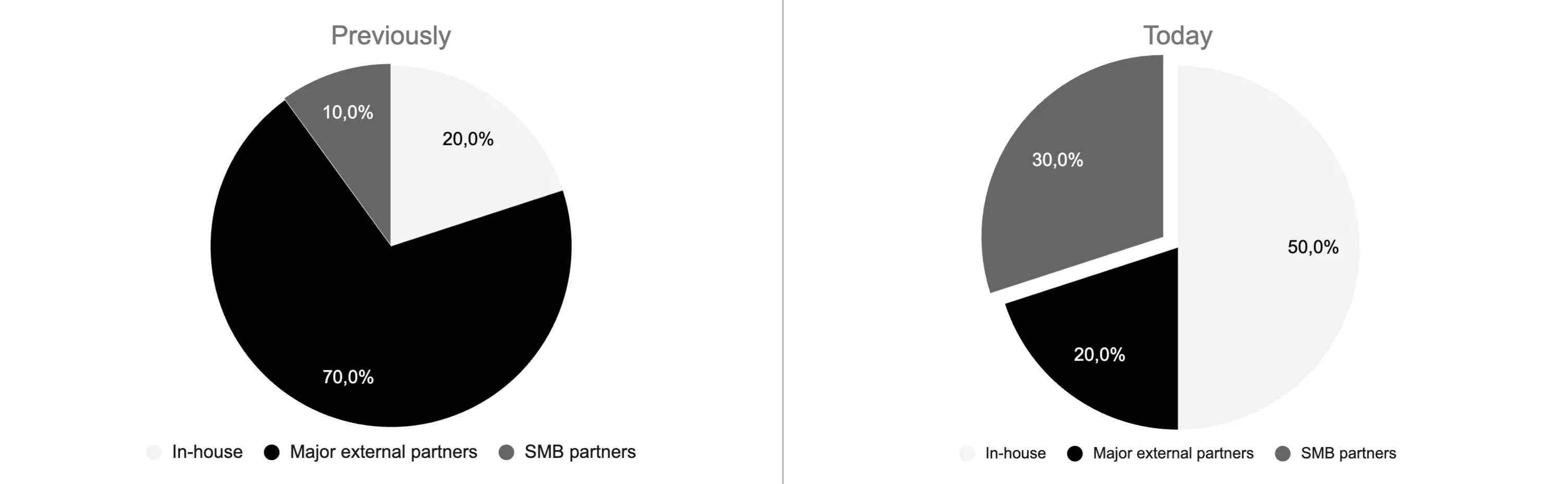
Previously, getting SDV (software-defined vehicle)-development work done in the automotive industry meant awarding large development contracts to a few large partners that contributed with a major workforce.
However, this has changed, with software becoming a defining factor in how quickly vehicles are pushed to market and function in the hands of the customer. Additionally, the entire development process and time-to-market have undergone significant changes with an AI-powered workforce that completes work faster than ever before.
The Big Shift: From Large External Partners to Agile SMBs & In-House Development
Ever since automotive companies recognized that software is the new core of vehicle development, they have shared the understanding that it needs to be developed under their control and in an agile manner.
Awarding a $100M contract to develop a software component over 4 years doesn’t cut it anymore. The pace of change is too fast, and customers expect software updates to be pushed to their vehicles continuously and immediately.
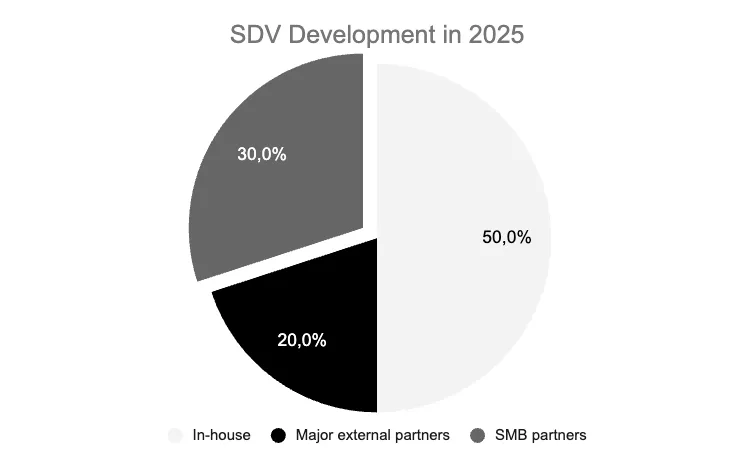
While the 2010s and 2020s so far have been dominated by large external players, we now see a clear trend of more work being moved either in-house hiring or awarded to product-oriented delivery teams from smaller, more agile suppliers.
How the landscape has changed for modern software-defined vehicle development
In this article, we will examine a few key criteria for evaluating SMB suppliers in this new world.
The New Criteria for SDV Supplier Evaluation
It was easier to choose a supplier for your project previously. You had a few large partners you always worked with and could trust to deliver what you needed. Today’s reality is different. New players have formed smaller, and more agile teams that develop both software components and services much faster than traditional legacy suppliers could.
Evaluating these suppliers through traditional metrics (headcount, location, previous relationship) isn’t enough anymore. A new method is needed. We have therefore assembled a list of 12 data points to look for when evaluating next-gen SDV suppliers:
New Signal
Why It Matters Now
1. Depth of Technical IP (e.g. zero-copy middleware, HSM stack)
Self-developed tools & software products show ownership of critical functions by not just being integrators, but inventors.
2.Granular Team Transparency
Can you see who’s on the team, their background, and availability? Vague “100 engineers” ≠ readiness.
3. OEM-Specific Engineering History
Have they built for a TDA4 SoC in a Geely EV? That’s 10x more relevant than general “ADAS experience.”
4. Integration Readiness
Are they ready to work with your AUTOSAR variant, CI/CD toolchain, OTA workflows? Or will they slow you down?
5. Delivery Model Fit
Can they embed into your agile workflow via staff augmentation, or deliver packaged software under fixed scope?
6. Certifications Beyond the Basics
ISO 26262 is the entry ticket. Who’s got ISO/SAE 21434, TISAX, and PMP-trained PMs too?
7. Validation & Localisation Capability
Can they take a system all the way through Euro NCAP road validation, not just write code?
8. Breadth of Deployment Contexts
Have they worked in BEVs, retrofits, autonomy platforms, or across L1–L4 levels? That tells you their real-world range.
9. Product-Mindedness
Do they just take specs and code, or contribute product architecture and design? Look for true R&D partners.
10. Pricing Predictability
Clear weekly/monthly pricing by team or domain gives buyers clarity and enables fast comparison.
11. IP Ownership & Reusability
Can they license proven ADAS components, or will you pay to reinvent the wheel every time?
12. Narrative Clarity
Do they communicate like a modern tech company with case studies, product detail, real team intros? Or are they hiding behind buzzwords?
Why Most Suppliers Don’t Share This, and How to Get It
Most suppliers don’t volunteer this kind of granular information, not because they’re hiding it, but because no one ever asked in the right way.
Traditional RFQs and directories only capture surface-level facts: headcount, office locations, and vague service categories. Digging deeper usually means weeks of email chains, PDF brochures, and unstructured sales calls, all of which make meaningful comparison nearly impossible.
Hashlist solves this by standardizing supplier profiles across 100+ vendors. Every supplier is onboarded with structured data covering certifications, delivery models, team compositions, pricing, past customers, and technical competencies, making apples-to-apples comparison finally possible.
You can filter by ECU type, toolchain expertise, cybersecurity certifications, or even specific SoC experience, and immediately see which suppliers match. Instead of chasing information, buyers are now empowered to discover and shortlist relevant vendors in minutes.
Conclusion: The Right Supplier Isn’t Just “Automotive.” They’re SDV-Ready.
In the new world of automotive development, the best suppliers aren’t the biggest. They’re the fastest, most product-minded, and deeply integrated with modern SDV toolchains.
If you’re still evaluating partners using legacy criteria, you risk missing the companies that can actually move your program forward.